Cruxl resources
Learn to map what you know.
Every public Cruxl guide in one place: mind-mapping foundations, note-taking, essay planning, college-application story discovery, and ways to turn your own material into a map.
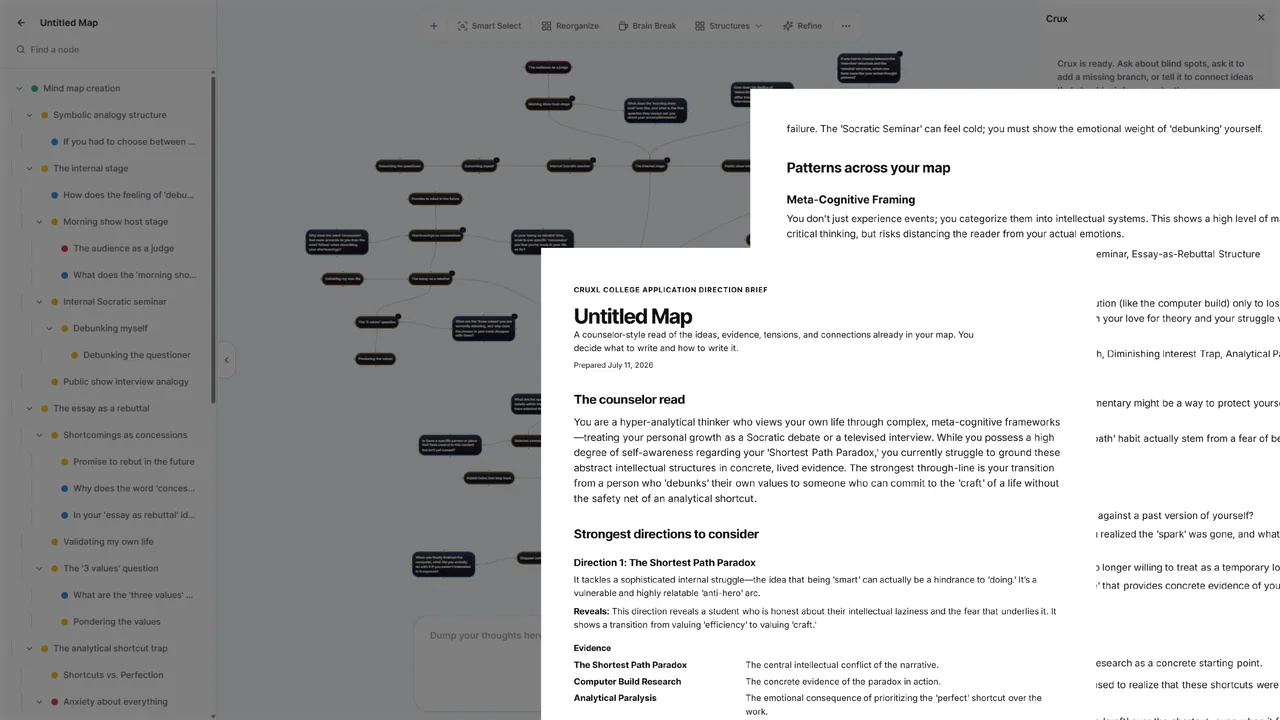
Mind mapping for students: a practical guide to clearer thinking
Learn how students can use mind maps to understand a topic, plan an essay, organize notes, and find gaps without handing their thinking to AI.
Read the guide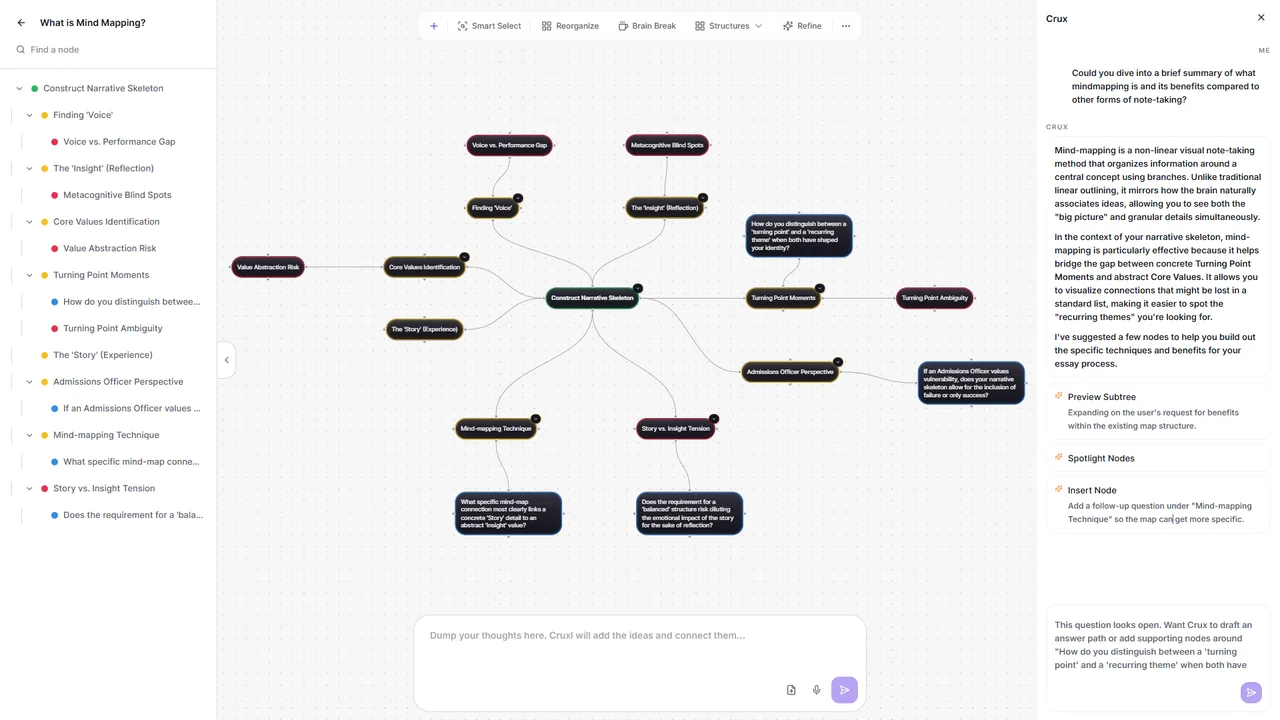
How to make a mind map that stays useful
A step-by-step method for making a mind map by hand or with software, including how to choose branches, show relationships, and avoid clutter.
Read guideWhat is a mind map? Definition, uses, and what one looks like
See what a mind map is, what it looks like, what it is used for, and how it differs from an outline or concept map.
Read guideNotes and essay planning
Use a map to connect class notes, claims, evidence, examples, counterarguments, and unanswered questions before the structure settles.
The mapping method of note-taking: how mind-map notes work
Learn how the mapping method of note-taking groups ideas and relationships, when it works better than linear notes, and how to review the map afterward.
Read guideEssay mind map: plan claims, evidence, and structure visually
Use an essay mind map to connect the prompt, possible claims, evidence, counterarguments, and gaps before arranging paragraphs.
Read guideFind a college essay direction
Notice real moments and compare possible story branches without admissions scoring, fabricated drama, or a generated response.
College essay brainstorming questions that find real stories
Questions designed to uncover moments, choices, tensions, details, and reflection—not generate a polished essay topic for you.
Read guideHow to find a college essay topic that is actually yours
A practical process for choosing an essay direction from your real experiences without forcing a dramatic story or copying accepted examples.
Read guideCollege essay ideas when nothing interesting happened
Find usable college essay material in ordinary responsibilities, routines, relationships, decisions, and questions without inventing drama.
Read guideHow to choose between two college essay topics
Compare two possible college essay directions by specificity, agency, tension, reflection, and what each reveals beyond the rest of the application.
Read guideDevelop the direction for a prompt
Connect student-owned material to Common App and supplemental prompts, then make the evidence more specific before drafting.
Common App essay brainstorming without losing your voice
Use the Common App personal essay prompts as lenses for real experiences, then develop the moments, choices, details, and reflection that belong to you.
Read guideSupplemental essay brainstorming without writing the response
Break a supplemental prompt into its real job, connect it to student-owned evidence, and find the missing research or reflection before drafting.
Read guideHow to make a college essay less generic before you draft
A prewriting method for replacing broad claims about growth, leadership, and resilience with concrete moments and honest reflection.
Read guideTurn your material into a map
See exactly how Cruxl currently works with a short voice recording, pasted text, or a PDF inside the authenticated composer.
Audio to mind map: turn a short voice note into a visual map
Record up to 60 seconds of speech in Cruxl, turn the transcript into an editable mind map, and keep developing the questions and branches that matter.
Read guideText to mind map: turn pasted notes into editable structure
Paste or type text into Cruxl, create a connected mind map from the material, and revise the branches instead of settling for a static summary.
Read guidePDF to mind map: turn a document into editable branches
Upload a PDF to a private Cruxl workspace, extract its material into an editable map, and keep source-grounded questions beside the relevant branches.
Read guideWhen a list is not enough, map the material.
See ideas, evidence, moments, tensions, and unanswered questions at the same time, then keep developing the branch that matters.
Create a free mind map