College essay brainstorming
Find the story that is actually yours.
Turn your real moments, choices, details, and questions into a visual story map before you draft. Cruxl helps you discover what is worth writing without writing the application for you.
Free plan available. Your ideas and writing stay yours.
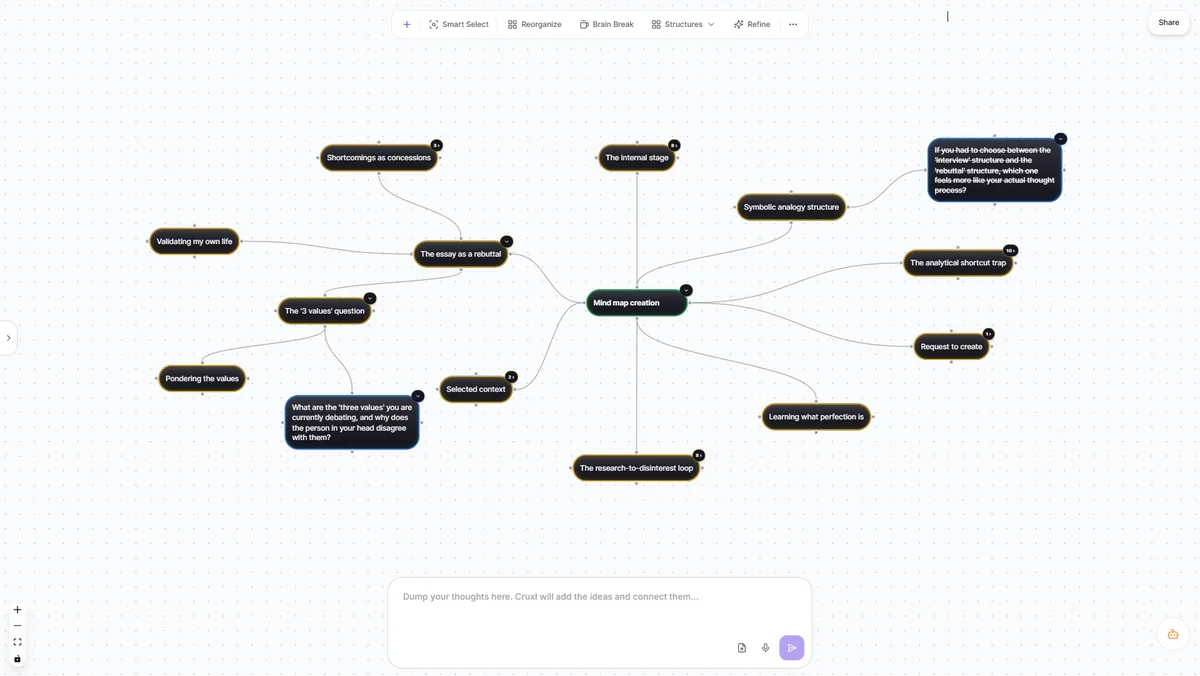
The blank page is usually not the real problem.
You have experiences, but they feel ordinary.
The useful material may be a small decision, recurring tension, or detail you have stopped noticing—not a dramatic achievement.
Your activities list sounds like a résumé.
Cruxl helps separate what you did from the moments, choices, consequences, and meaning underneath it.
Every idea turns into “I grew.”
A map makes vague growth claims visible so you can ask what changed, when it changed, and what evidence supports it.
You are trying to draft too early.
Before sentences, you need enough real material to choose a direction you can defend and develop in your own voice.
From scattered memories to a direction you can write from.
The map is not the final essay. It is the thinking space where you discover what is concrete, connected, weak, or still unanswered.
- 01
Start with the mess
Add the application prompt, a rough note, saved material, a file, or a short voice thought. It does not need to sound polished.
- 02
Map what actually happened
Cruxl separates moments, people, choices, stakes, consequences, details, values, and reflection into an editable story map.
- 03
Find what is still thin
Crux surfaces missing scene details, weak connections, unresolved tensions, and questions that could make the material more specific.
- 04
Choose your direction
Grow the branch that feels true, then create a direction brief grounded in the ideas and evidence already in your map.
Leave with a counselor-style read of your own map.
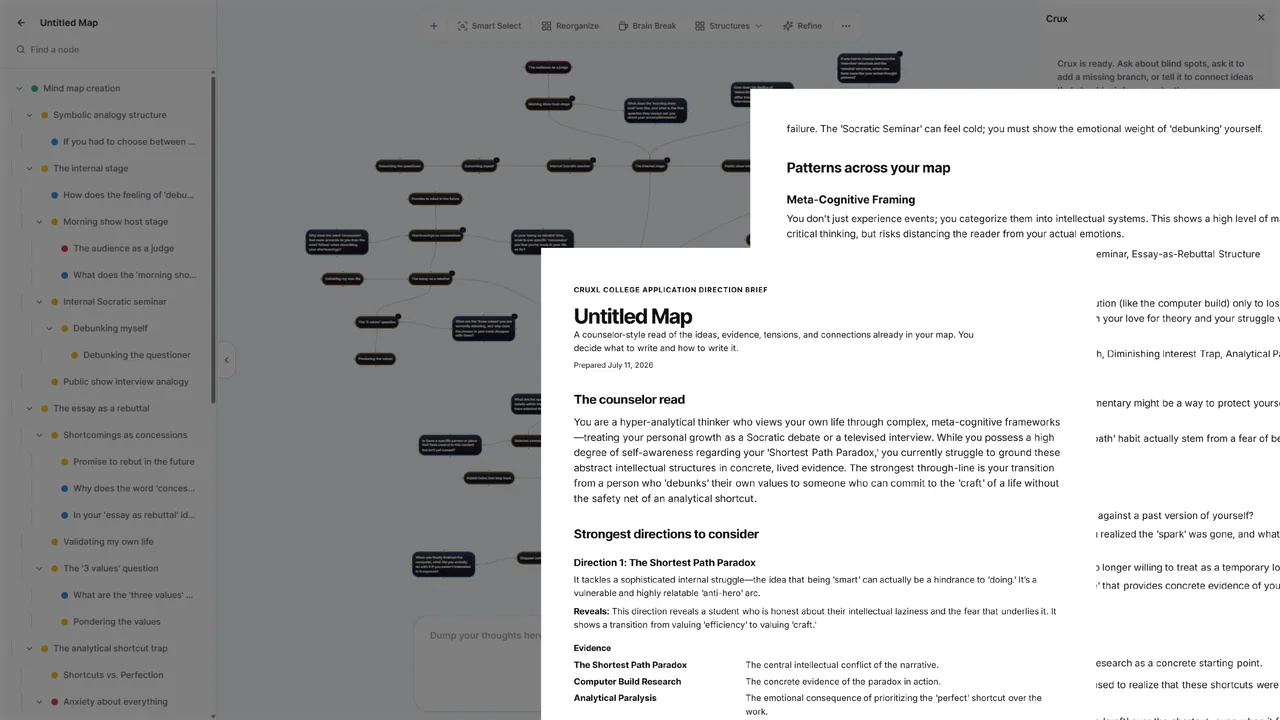
When the map has enough material, Cruxl can create an application direction brief: strongest paths, evidence already present, patterns across the map, watchouts, and questions to answer before drafting.
- Grounded in the nodes and connections you created
- Built to help you choose, not to choose for you
- No hooks, paragraphs, or polished application prose
AI support with a clear boundary.
Cruxl is designed for the thinking before student writing. The student supplies the life, decides the direction, and writes the submission.
Cruxl helps you
- See concrete moments and choices separately from generic claims
- Find missing details, tensions, consequences, and reflection
- Compare possible directions using your own evidence
- Keep developing the same editable map
Cruxl does not
- Invent an experience or emotional lesson for you
- Score your odds of admission
- Optimize your story to imitate accepted essays
- Generate the essay you submit
Questions students ask before starting.
Does Cruxl write my college essay?
No. Cruxl maps and questions the material you provide. You decide which story matters and write the application in your own words.
What can I start with?
You can start with a Common App or supplemental prompt, a rough memory, an activities list, an old draft, a saved note, a file, or a short voice recording.
What is an application direction brief?
It is a counselor-style read of the strongest directions, supporting evidence, cross-map patterns, watchouts, and questions already present in your map. It is not application prose.
Can I change the map after Cruxl creates it?
Yes. The map is editable. You can add thoughts, answer questions, reorganize connections, grow branches, and keep developing the same material.
Start with a useful exercise.
No topic generator. No promise of a perfect story. Just concrete ways to uncover and test your own material.
College essay brainstorming questions
Questions that surface moments, agency, tension, and reflection.
Read guideHow to find your college essay topic
A process for choosing from real experiences without forcing a dramatic arc.
Read guideHow to make an essay less generic
Turn vague growth language into specific evidence before you draft.
Read guideYour story does not need to sound impressive yet.
Start with what is true. Map the moments. Find the question that makes one of them worth developing.
Start your story map