Cruxl can turn a short in-app voice recording into mind-map material. The current composer records for up to 60 seconds, transcribes the speech, and adds the transcript to the same brief used to create the map.
This is not a public audio-file converter, and the current composer does not advertise long recordings. It is a fast way to capture one thought when speaking is easier than typing, then inspect and revise the resulting structure.
How voice becomes an editable mind map
- Open the authenticated map composer and choose the microphone control.
- Record one bounded thought for up to 60 seconds.
- Cruxl transcribes the recording and places the text in the composer.
- Review or edit the transcript before creating the map.
- Keep, rename, move, connect, or remove the generated nodes after the map opens.
What works well in a 60-second recording
- One problem with the competing ideas or constraints named aloud.
- A rough explanation of a topic with the points that feel connected.
- A remembered moment with people, choices, details, and consequences.
- A quick recap of notes followed by the question that still feels unresolved.
The current recording boundary
The live composer stops at 60 seconds. It does not currently accept an arbitrary uploaded audio file through this flow. The short recording is transcribed for the composer and is not stored as product data after transcription.
For longer material, paste existing text or use a supported document instead of assuming the voice control will process a lecture or podcast recording.
The first map is a starting structure
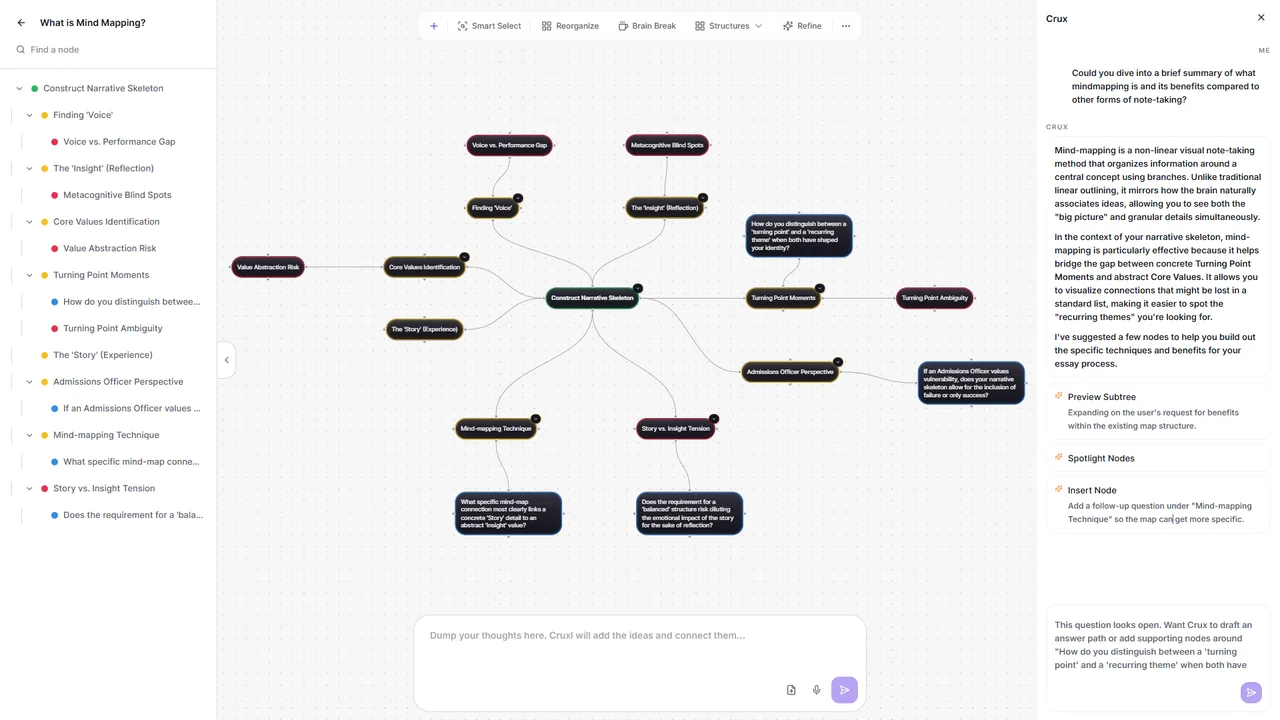
Speech contains repetitions, unfinished sentences, and ideas discovered mid-thought. The first map proposes a structure for that material. The useful work is checking whether the branches reflect what was meant, then changing the map until the relationships make sense.
Why the result is more useful than a frozen summary
A summary compresses the recording. A mind map keeps several ideas and their relationships visible so the user can move branches, add missing detail, ask Crux about a weak connection, or continue from the same material later.
Speak one short thought, then work with its structure.
The current Cruxl composer records up to 60 seconds, transcribes the speech, and uses that text as material for an editable map.
Record a thought in Cruxl